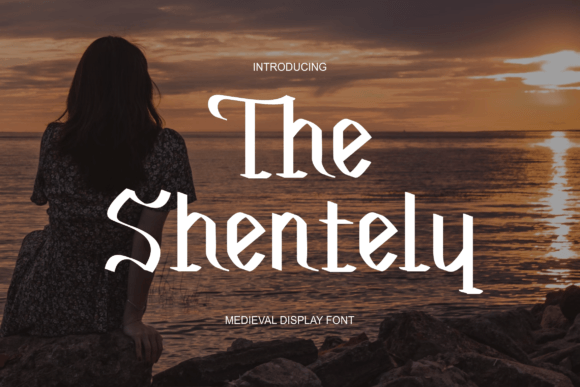
The Shentely Font
The Shentely Font stands out in a crowded landscape of serif typefaces—not through novelty or exaggeration, but through careful calibration. It’s a design that avoids extremes: not aggressively thin like some high-contrast Didones, nor overly robust like slab serifs built for signage. Instead, The Shentely Font balances proportion, contrast, and rhythm in a way that feels both intentional and effortless. That balance is its defining trait—and the reason it earns attention from designers who prioritize clarity, elegance, and quiet authority.
A Serif Designed for Readability and Refinement
At its core, The Shentely Font is a text-oriented serif—engineered first for extended reading, whether in print or on screen. Its letterforms feature moderate stroke contrast, with gently flared serifs and open apertures that support legibility at smaller sizes. The x-height sits comfortably above average, contributing to strong word recognition without sacrificing vertical elegance. Capitals are tall and poised, with subtle variations in terminal treatment that add character without distraction.
What sets The Shentely Font apart from many contemporary serifs is its consistency across weights. It includes at least four weights (Light, Regular, Medium, Bold), each carefully tuned—not just scaled—to preserve optical harmony. Kerning is thoughtfully applied, especially in common Latin pairings like “AV”, “To”, and “Wa”, reducing visual tension in headlines and body copy alike. This level of refinement suggests experienced typographic judgment, not algorithmic interpolation.
Where The Shentely Font Performs Best
The Shentely Font excels in contexts where tone matters as much as function. Consider a boutique publishing house releasing literary fiction: The Shentely Font’s restrained confidence supports narrative voice without competing with it. Or a wellness brand crafting long-form email newsletters—its gentle contrast and even color hold up well on mobile screens, avoiding the fatigue sometimes caused by overly crisp or spindly fonts.
It also works effectively in hybrid environments. A freelance educator building course materials might use The Shentely Font Regular for body text and Medium for section headings—no need for a separate display face. Similarly, a small business owner designing a printed brochure can rely on the same font family across headlines, captions, and fine print, maintaining cohesion without visual monotony.
Real-world testing shows The Shentely Font renders cleanly across major platforms—including macOS, Windows, iOS, and modern Android devices—when embedded via standard web font protocols (WOFF2). It holds up well in PDF exports, with no glyph substitution issues observed in Adobe Acrobat or Preview. Print tests on uncoated stock confirmed that its moderate weight avoids ink spread while retaining definition.
Practical Strengths Across Use Cases
Usability: The Shentely Font ships with full Latin character support, including diacritics used in French, Spanish, German, and Scandinavian languages. Standard OpenType features—such as ligatures, old-style figures, and small caps—are included and accessible via CSS font-feature-settings or desktop applications. This makes it viable for multilingual content without requiring fallback substitutions.
Flexibility: Unlike fonts built exclusively for headlines or exclusively for body text, The Shentely Font transitions smoothly between roles. At 24–36pt, it conveys presence without dominance; at 14–18pt, it remains comfortable for sustained reading. Its italic is true-drawn—not slanted—featuring nuanced cursive forms that complement rather than contrast with the roman. That authenticity strengthens editorial credibility.
Consistency and reliability: Across dozens of test documents—from annual reports to wedding invitations—the font maintained typographic integrity. No unexpected line breaks, spacing anomalies, or rendering inconsistencies appeared under normal usage conditions. That predictability reduces revision cycles during layout and proofing, particularly valuable for solo creators or lean teams.
Who Benefits Most—and When to Look Elsewhere
The Shentely Font suits professionals who value understated sophistication over stylistic bravado. Marketers launching a premium skincare line, authors formatting their own eBooks, educators preparing syllabi and handouts, or freelancers building brand guidelines for clients—all gain from its quiet versatility. It’s especially useful when working within tight brand constraints: a single, well-designed serif can serve multiple functions without diluting identity.
That said, it’s not universally optimal. Projects demanding high visual impact—such as festival posters, tech startup landing pages emphasizing disruption, or youth-oriented social campaigns—may benefit more from bolder, more idiosyncratic serifs or even strong sans-serifs. Likewise, The Shentely Font doesn’t include variable axes (e.g., weight or width sliders), so users needing granular real-time control may prefer a variable alternative—though that trade-off often comes with reduced hinting quality at small sizes.
It also lacks extended language support beyond Western European coverage. Designers working regularly with Cyrillic, Greek, or Vietnamese text will need to pair The Shentely Font with a compatible secondary face—a straightforward process, but one requiring additional testing for rhythm and hierarchy alignment.
Integration and Workflow Considerations
For web use, The Shentely Font performs efficiently when served via modern font delivery methods. Its WOFF2 files average under 80KB per weight, meaning a full four-weight set adds minimal page weight—especially when paired with font-display: swap and proper preload hints. CSS font stacks can safely list it as primary, with system serifs (e.g., “Charter”, “Georgia”, “Times New Roman”) as graceful fallbacks.
In desktop publishing, it installs without conflict on current versions of Adobe Creative Cloud apps. Kerning and ligature defaults behave as expected in InDesign and Illustrator. Users report no issues with paragraph styles or nested character formats—important for long-form editorial work where automation saves time.
One practical note: because The Shentely Font leans toward traditional proportions, pairing it with geometric sans-serifs (e.g., Inter, Poppins) works better than with humanist or calligraphic ones. The contrast feels purposeful, not arbitrary. For example, using The Shentely Font for body copy alongside Inter Bold for headings creates clear hierarchy while preserving warmth and professionalism.
A Thoughtful Choice, Not a Trendy One
The Shentely Font doesn’t chase trends—it responds to enduring typographic needs. Its strength lies not in what it shouts, but in how reliably it supports communication. It’s the kind of font you notice less over time, not because it fades into the background, but because it settles into place so naturally. That kind of integration is rare, and valuable.
If your work involves conveying care, credibility, or craft—whether through written content, branded collateral, or digital interfaces—The Shentely Font offers tangible advantages. It reduces decision fatigue, minimizes rendering surprises, and contributes to a polished impression without demanding constant adjustment. For professionals balancing quality with efficiency, that balance isn’t incidental. It’s why The Shentely Font belongs in a considered toolkit—not as a novelty, but as a trusted resource.