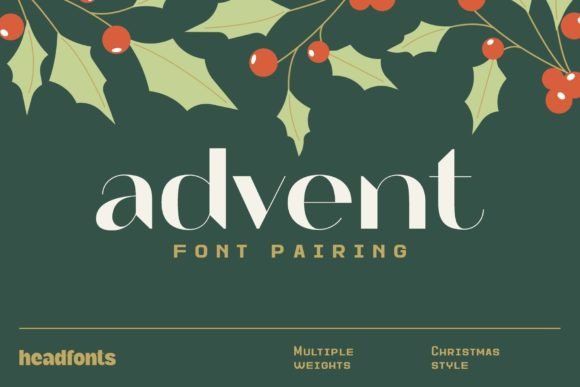
Advent Font Pairing: Festive Elegance Meets Clean Geometry
If you’ve ever stared at a holiday design—whether it’s a boutique’s gift tag, a newsletter header, or a social media carousel—and felt something was *almost* right but not quite, the issue might not be layout or color. It could be typography. Not just any type—but the right pairing. That’s where Advent Font Pairing stands apart: not a single font, but a thoughtfully balanced duo—Arthead and Retrohead—designed to work in concert, not competition.
A Contrast That Feels Intentional, Not Contrived
Arthead is your elegant anchor: a refined serif with subtle calligraphic warmth, delicate terminals, and generous letter spacing. Think of it as the hand-lettered sign above a candlelit bookstore—graceful, timeless, quietly luxurious. It’s not overly ornate, but it carries presence. It works beautifully as a display font for headlines, invitations, or logo lockups where you want sophistication to land first.
Retrohead, by contrast, is a crisp, geometric sans serif—no frills, no fuss. Its uniform stroke weight, open apertures, and friendly proportions make it highly legible at small sizes and on screen. It’s the kind of typeface that feels equally at home on a minimalist coffee sleeve or a responsive email footer. Together, they form a pairing that avoids visual fatigue: one draws attention, the other delivers clarity.
This isn’t just “serif + sans” by default. The four combined styles—Arthead Regular & Italic, Retrohead Regular & Bold—are calibrated to share rhythm and scale. Their x-heights align closely. Their weights complement without competing. That harmony means less time adjusting tracking or line height—and more time focusing on your message.
Where This Duo Earns Its Place
Advent Font Pairing thrives where festive meets functional. For designers building seasonal brand extensions—say, a skincare line launching a limited-edition winter collection—it offers instant cohesion: Arthead for product names and hero banners, Retrohead for ingredient lists, pricing, and CTAs. The contrast reinforces hierarchy without sacrificing warmth.
Bloggers and content creators use it for holiday roundups, gift guides, or printable checklists. A bold Arthead headline (“12 Days of Cozy Reads”) paired with clean Retrohead body text ensures scannability on mobile while keeping tone inviting—not clinical.
In packaging design, the pairing shines on tactile surfaces: foil-stamped Arthead on matte kraft boxes, grounded by uncoated Retrohead labels. Print designers report fewer revisions when clients see how effortlessly the fonts balance “special occasion” and “everyday usability.”
Small business owners running Etsy shops or local craft fairs find it especially practical. One license covers digital ads, printed tags, Instagram Stories, and PDF lookbooks—no need to juggle multiple fonts or licenses. And because Retrohead renders well across browsers and devices, web design projects maintain consistency whether viewed on Safari, Chrome, or even older email clients.
Readability, Hierarchy, and the Unspoken Trust Factor
Type choices quietly shape perception. Arthead signals care, intention, and attention to detail—qualities that elevate perceived value. Paired with Retrohead’s straightforwardness, it avoids pretension. You’re not shouting “luxury”; you’re offering it with quiet confidence.
That balance directly supports visual hierarchy. In editorial design, for example, Arthead can define section headers (like “Holiday Tablescapes”), while Retrohead handles subheads and body copy—guiding the eye without abrupt jumps in tone or weight. Readers absorb structure intuitively, which boosts engagement and retention.
For marketers, this translates to stronger brand recognition. Consistent use across touchpoints—website, packaging, social posts—builds familiarity. Over time, audiences begin associating that particular serif/sans interplay with your seasonal voice. That’s not accidental. It’s strategic typography working behind the scenes.
Practical Tips Before You Commit
Before licensing Advent Font Pairing, test it in context—not just as isolated samples. Drop Arthead into your actual headline template and Retrohead into your body copy style guide. Adjust letter spacing only if needed; both fonts were designed with generous default metrics.
Check readability at real-world sizes: 14–16px for digital body text, 24–36px for print subheads, 60px+ for hero banners. Retrohead holds up exceptionally well below 12px—useful for footnotes or QR code labels. Avoid using Arthead below 18px in print or 24px on screen unless it’s purely decorative.
Review the included styles carefully. Both fonts include standard Latin character sets, basic punctuation, and numerals—but no extended language support (e.g., Cyrillic or Vietnamese). If your audience includes multilingual readers, plan for fallbacks or supplemental typefaces.
Licensing is straightforward: one commercial license covers unlimited projects for a single user or business entity. No per-page fees, no renewal traps. You can embed Retrohead in PDFs or use Arthead in animated social assets—just avoid modifying the font files themselves.
Real-World Observations From Designers Who Use It
One publisher told us they switched from a popular script + sans combo to Advent Font Pairing for their annual holiday magazine—and cut client revision rounds by nearly half. “Clients kept asking to ‘make the script less fancy.’ With Arthead, they said, ‘Yes, that’s exactly the tone we wanted.’”
A greeting card designer noted how Retrohead Bold improved scan rates on Instagram carousels: “People actually read the fine print now—pricing, shipping deadlines, personalization options. Before, they’d skip straight to the ‘Add to Cart’ button.”
And a café owner using the pair for window decals and loyalty cards reported customers commenting on how “warm but not cutesy” the signage felt—proof that thoughtful typography resonates beyond the design community.
Ultimately, Advent Font Pairing isn’t about chasing trends. It’s about having a reliable, expressive tool that does heavy lifting without demanding attention. When your goal is to celebrate the season—not the typeface—this duo gets out of the way, so your message, your brand, and your audience take center stage.