Hallowed Eve Font
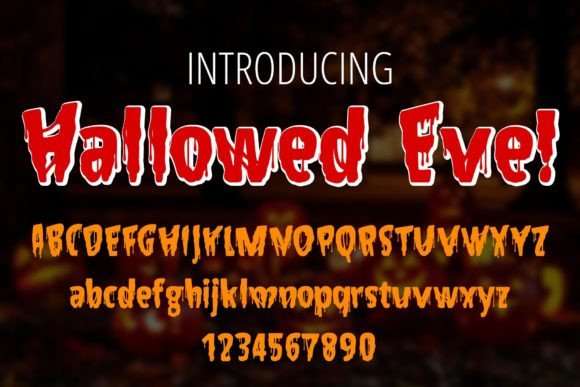
If you’ve ever spent hours searching for a typeface that truly captures the spirit of Halloween—without veering into cartoonish cliché or overused gothic clichés—you’ve likely landed on Hallowed Eve Font. Designed specifically for Halloween fanatics, this font balances eerie elegance with bold legibility. It’s not just “spooky”—it’s thoughtfully crafted: sharp serifs, subtle asymmetry, and glyphs that feel hand-carved yet digitally precise. Whether you’re designing a haunted house flyer, branding a seasonal small-batch cider label, or titling an indie horror short film, Hallowed Eve Font delivers atmosphere without sacrificing function.
Why It Stands Out (and Why That Matters)
Many Halloween fonts rely too heavily on dripping blood, wobbly outlines, or excessive ornamentation—traits that look great at 120pt on a banner but vanish into illegibility at 24pt on a phone screen or fade when printed on kraft paper. Hallowed Eve Font avoids those pitfalls. Its letterforms maintain strong contrast and open counters (the enclosed spaces in letters like ‘e’, ‘a’, and ‘o’), which improves readability across sizes and surfaces. That’s why designers use it for t-shirt prints that hold up after multiple washes, and why educators choose it for classroom posters that need to be seen—and understood—from the back row.
Common Missteps—and How to Skip Them
Even experienced creators sometimes misjudge how a display font like Hallowed Eve Font behaves in real-world use. Here’s what often goes wrong—and how to fix it before you commit:
- Assuming it works for body text. This font is a display face—not meant for paragraphs, captions, or website menus. Using it for more than a headline or short phrase can strain readability and confuse hierarchy. Instead, pair it with a clean, neutral sans-serif (like Montserrat or Inter) for supporting text. That contrast strengthens your message rather than competing with it.
- Overlooking licensing scope. Some users download free variants only to discover later they’re restricted to personal use—or lack OpenType features like ligatures or alternate glyphs. If you’re using Hallowed Eve Font for a client’s haunted bakery menu or an Etsy shop banner, verify the license covers commercial use *and* includes webfont files if needed for email campaigns or landing pages.
- Ignoring color contrast in print. The font’s textured edges and slight irregularity look dramatic in black-on-white—but can blur or fill in when printed in dark gray on navy or reversed out of foil-stamped black. Always test a physical proof, especially for invitations or packaging. A quick tip: try 90% black instead of 100% for smoother ink laydown on uncoated stock.
- Skipping glyph coverage checks. Not all Halloween fonts support accented characters, fractions, or currency symbols. If your event spans bilingual communities (e.g., “Día de Muertos Night” or “£5 Entry”), confirm Hallowed Eve Font includes Latin-1 or extended Latin support—not just the basic A–Z set. Missing glyphs may default to a system font, breaking visual consistency.
What to Check Before You Download—or Buy
Before adding Hallowed Eve Font to your project, ask yourself three practical questions:
- Where will it live? Is this for static print (posters, stickers), digital display (Instagram stories, email headers), or motion graphics? Each medium has different technical needs—web use requires WOFF2 files and proper CSS embedding; embroidery digitizing needs simplified vector paths.
- Who’s the audience—and what’s the goal? A band logo for a doom-metal group benefits from the font’s weight and tension. But a preschool Halloween party invite might need softer spacing and friendlier kerning. Preview the font in context—not just as isolated letters on a preview site.
- Do I have fallbacks ready? Even with perfect licensing, technical hiccups happen. Keep a compatible backup font (e.g., Cinzel or Playfair Display) pre-loaded in your design file or CSS stack. That way, if Hallowed Eve Font fails to load, your layout doesn’t collapse.
Better Pairings, Smarter Workflow
Pairing Hallowed Eve Font well isn’t about matching “vibes”—it’s about balancing contrast and purpose. Avoid other decorative fonts unless they serve a distinct role (e.g., a thin script for “Est. 2012” beneath a bold Hallowed Eve Font headline). Instead, lean into typographic harmony: use its natural rhythm to guide spacing. For example, increase line height by 1.4x when stacking stacked words (“HALLOWED EVE”) to preserve its dramatic vertical flow. And always adjust tracking manually—auto-kerning rarely handles its uneven terminals correctly.
One real-world example: A small business owner used Hallowed Eve Font for her pumpkin spice candle line labels but initially set the price in the same font at 10pt. Customers missed it entirely. Switching the price to a crisp, medium-weight sans-serif at 12pt—while keeping the product name in Hallowed Eve Font—increased perceived value *and* scannability at market stalls.
A Final Note on Intentionality
Great Halloween design isn’t about how much “scary” you pack in—it’s about clarity, mood, and respect for the viewer’s time and attention. Hallowed Eve Font supports that intention when used deliberately: as a focal point, not filler; as punctuation, not paragraph. It rewards thoughtful application—not just seasonal impulse.
So whether you’re sketching on paper, building in Figma, or coding a Shopify banner, let the font do the haunting—and keep your choices grounded in purpose, testing, and real-world constraints. That’s how you turn seasonal energy into lasting impact.